Martin Dörr > > > contact ( a t ) martindoerr.de > > > C V > GAME > IG > > > Last update 2026
Martin Dörr (*1990, Pirmasens, Germany) is an artist whose work explores collective structures, systemic behaviors, and structural couplings. His practice revolves around systemic experimentation, modeling, and the abstraction of complex systems. By engaging in collaborations with unconventional, non-human, and technical agents, Dörr intervenes in established structures—expanding and transforming them through alternative narratives, narrators, and modes of narration.
Lens Flare –
Vom physikalischen Phänomen zur non-linearen Erzählfigur LF
(2020, Marlies Schleicher Award for Art Theory)
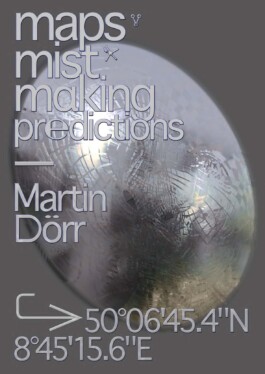
> Companion Publication to Maps*Mists*Making Predictions, 67 pages, published 2020.
Abstract // DAZZLED NAVIGATORS
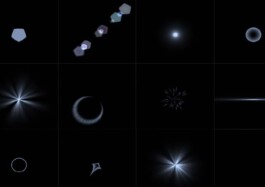
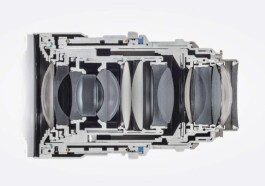
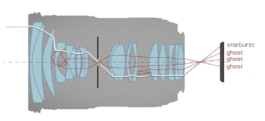
Lens Flares (LF) appear when photons abandon their intended path. Internally scattered within lens systems, they surface on the image plane as light artifacts: ghosts that make the medium itself visible; that mark the image not as a mirror of reality but as a result of a material, situated transmission.
This publication places LF, the blind spots at the centre of observation and uses it as a carrier and speculative figure for thought. It follows LF’s multiple non-linear paths: through the physics of the lens body; through media history, where LF emancipated itself from image error to intended effect across propaganda film, New Hollywood, science fiction, and digital simulation; and into the atmospheric register, where LF shapes image spaces without announcing itself. A meteorology of perception that opens ne, dazzled paths in and out of the image. LF is a queer materialization within the logic of the linear image apparatus; a body whose presence is an opening for other non-linear figures and narratives.
Drawing on Serres‘ mineral cave, Haraway’s SF, Ahmed’s queer phenomenology, and Böhme’s atmosphere theory, LF becomes a fleeting figure of the in-between:navigating between real and image space, fact and fiction, linear representation and the non-linear conditions of its emergence.
The publication concludes with A Mineral Fiction for Alternative Cave Exits.
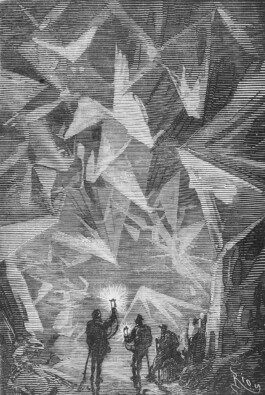
The speculative text picks up at the end of the description of a crystalline cave from Jules Verne’s adventure novel L’Étoile du Sud. Le Pays des diamants (1884), which the philosopher and mathematician Michel Serres uses in his essay Le gaucher boiteux – Figures de la pensée (2014) to convey an anti-Platonic worldview/analogy. In this fictional chapter added to Verne’s story, the central-perspective heroic narrative of Verne’s book dissolves, giving way to a multiperspectival, branching, and informing “mineral fiction” in reference to Serres’ conceptual framework („I too am a diamond“).
A Mineral F(r)iction for Alternative Cave Exits
… It drove their bodies to the surface, the place for which they had actually descended. To bring the story to the upper world… That of the fantastic cave, glistening in the depth of the mountain. The completely dark tunnels they followed were made of an unusually smooth stone that seemed to carry them further and further, leading them up the mountain like bubbles rising in a thick layered liquid.
Without warning, a wave of intense light hit them both. Intuitively, the heroes tore their hands before their eyes to protect them from the blazing light of the surface. In that moment it became visible which story the two were telling – without ever having to say any of their well thought-out words about it. Instead of a shadow that darkened their field of vision and from whose protection they would have tried to perceive the first outlines of the surface, the light was shot by their arms and hands into countless fragments, striking their heads and bodies. Bodies that no longer consisted of flesh or hair, but of a clear, mineral materiality, similar to that found in the cave. They did not really know what had happened. Whether their eyes were adapting to the dazzling light or whether they were trapped in a state of being blinded and the following were only imaginary figures:
Their crystalline bodies had no resistance to the light, eagerly absorbing it and radiating it in innumerable ways and directions imaginable. What disappeared glimmering against the horizon was their reality, the surface with its objects, spaces and values; outlines that had been replaced in favor of a sensing of things and materials that seemed to produce signs and instructions – constantly reconfiguring horizons without a heroic point of perspective. The intense light that had poured over them like a wave, bursting into a thousand flickering pieces. Fragments of themselves or of what they had become. A mineral fiction, a body of passage, a collector and transmitter, emitting and releasing, passing through, reflecting and diverting information from within and without. They could no longer distinguish between their crystalline self and their shimmering environment – which particle originated from which thing. It was a loss of themselves, a loss of their single shadow, replacing it by a new kind of numerous, (dazzling) shadows, shadows of n-order. Connected derivatives that branched into every microscopic pore – until the entire surface became part of this self-amplifying collective luminosity. A light becoming so bright that day and night dissolved, that compets with the dominance of the singular sun. A Light that carried the information of the collective depth far away to other celestial bodies and their inhabitants, turning towards or away from the story of the dazzling cave.
Martin Dörr > > > contact ( a t ) martindoerr.de > > > C V > GAME > IG > > > Last update 2026
Martin Dörr (*1990, Pirmasens, Germany) is an artist whose work explores collective structures, systemic behaviors, and structural couplings. His practice revolves around systemic experimentation, modeling, and the abstraction of complex systems. By engaging in collaborations with unconventional, non-human, and technical agents, Dörr intervenes in established structures—expanding and transforming them through alternative narratives, narrators, and modes of narration.
Lens Flare –
Vom physikalischen Phänomen zur non-linearen Erzählfigur LF
(2020, Marlies Schleicher Award for Art Theory)
> Companion Publication to Maps*Mists*Making Predictions, 67 pages, published 2020.
Abstract // DAZZLED NAVIGATORS
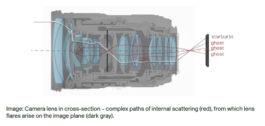
Lens Flares (LF) appear when photons abandon their intended path. Internally scattered within lens systems, they surface on the image plane as light artifacts: ghosts that make the medium itself visible; that mark the image not as a mirror of reality but as a result of a material, situated transmission.
This publication places LF, the blind spots at the centre of observation and uses it as a carrier and speculative figure for thought. It follows LF’s multiple non-linear paths: through the physics of the lens body; through media history, where LF emancipated itself from image error to intended effect across propaganda film, New Hollywood, science fiction, and digital simulation; and into the atmospheric register, where LF shapes image spaces without announcing itself. A meteorology of perception that opens ne, dazzled paths in and out of the image. LF is a queer materialization within the logic of the linear image apparatus; a body whose presence is an opening for other non-linear figures and narratives.
Drawing on Serres‘ mineral cave, Haraway’s SF, Ahmed’s queer phenomenology, and Böhme’s atmosphere theory, LF becomes a fleeting figure of the in-between:navigating between real and image space, fact and fiction, linear representation and the non-linear conditions of its emergence.
The publication concludes with A Mineral Fiction for Alternative Cave Exits.
The speculative text picks up at the end of the description of a crystalline cave from Jules Verne’s adventure novel L’Étoile du Sud. Le Pays des diamants (1884), which the philosopher and mathematician Michel Serres uses in his essay Le gaucher boiteux – Figures de la pensée (2014) to convey an anti-Platonic worldview/analogy. In this fictional chapter added to Verne’s story, the central-perspective heroic narrative of Verne’s book dissolves, giving way to a multiperspectival, branching, and informing “mineral fiction” in reference to Serres’ conceptual framework („I too am a diamond“).
A Mineral F(r)iction for Alternative Cave Exits
… It drove their bodies to the surface, the place for which they had actually descended. To bring the story to the upper world… That of the fantastic cave, glistening in the depth of the mountain. The completely dark tunnels they followed were made of an unusually smooth stone that seemed to carry them further and further, leading them up the mountain like bubbles rising in a thick layered liquid.
Without warning, a wave of intense light hit them both. Intuitively, the heroes tore their hands before their eyes to protect them from the blazing light of the surface. In that moment it became visible which story the two were telling – without ever having to say any of their well thought-out words about it. Instead of a shadow that darkened their field of vision and from whose protection they would have tried to perceive the first outlines of the surface, the light was shot by their arms and hands into countless fragments, striking their heads and bodies. Bodies that no longer consisted of flesh or hair, but of a clear, mineral materiality, similar to that found in the cave. They did not really know what had happened. Whether their eyes were adapting to the dazzling light or whether they were trapped in a state of being blinded and the following were only imaginary figures:
Their crystalline bodies had no resistance to the light, eagerly absorbing it and radiating it in innumerable ways and directions imaginable. What disappeared glimmering against the horizon was their reality, the surface with its objects, spaces and values; outlines that had been replaced in favor of a sensing of things and materials that seemed to produce signs and instructions – constantly reconfiguring horizons without a heroic point of perspective. The intense light that had poured over them like a wave, bursting into a thousand flickering pieces. Fragments of themselves or of what they had become. A mineral fiction, a body of passage, a collector and transmitter, emitting and releasing, passing through, reflecting and diverting information from within and without. They could no longer distinguish between their crystalline self and their shimmering environment – which particle originated from which thing. It was a loss of themselves, a loss of their single shadow, replacing it by a new kind of numerous, (dazzling) shadows, shadows of n-order. Connected derivatives that branched into every microscopic pore – until the entire surface became part of this self-amplifying collective luminosity. A light becoming so bright that day and night dissolved, that compets with the dominance of the singular sun. A Light that carried the information of the collective depth far away to other celestial bodies and their inhabitants, turning towards or away from the story of the dazzling cave.